
INSTITUTO DE EDUCACIÓN SECUNDARIA NAVARRO VILLOSLADA EN PAMPLONA: UN TABLERO DE JUEGO DE ESTRATEGIAS SOSTENIBLES PARA CENTROS EDUCATIVOS
Publicación de artículo científico en la Revista Planur-e de territorio, urbanismo, paisaje, sostenibilidad y diseño urbano.
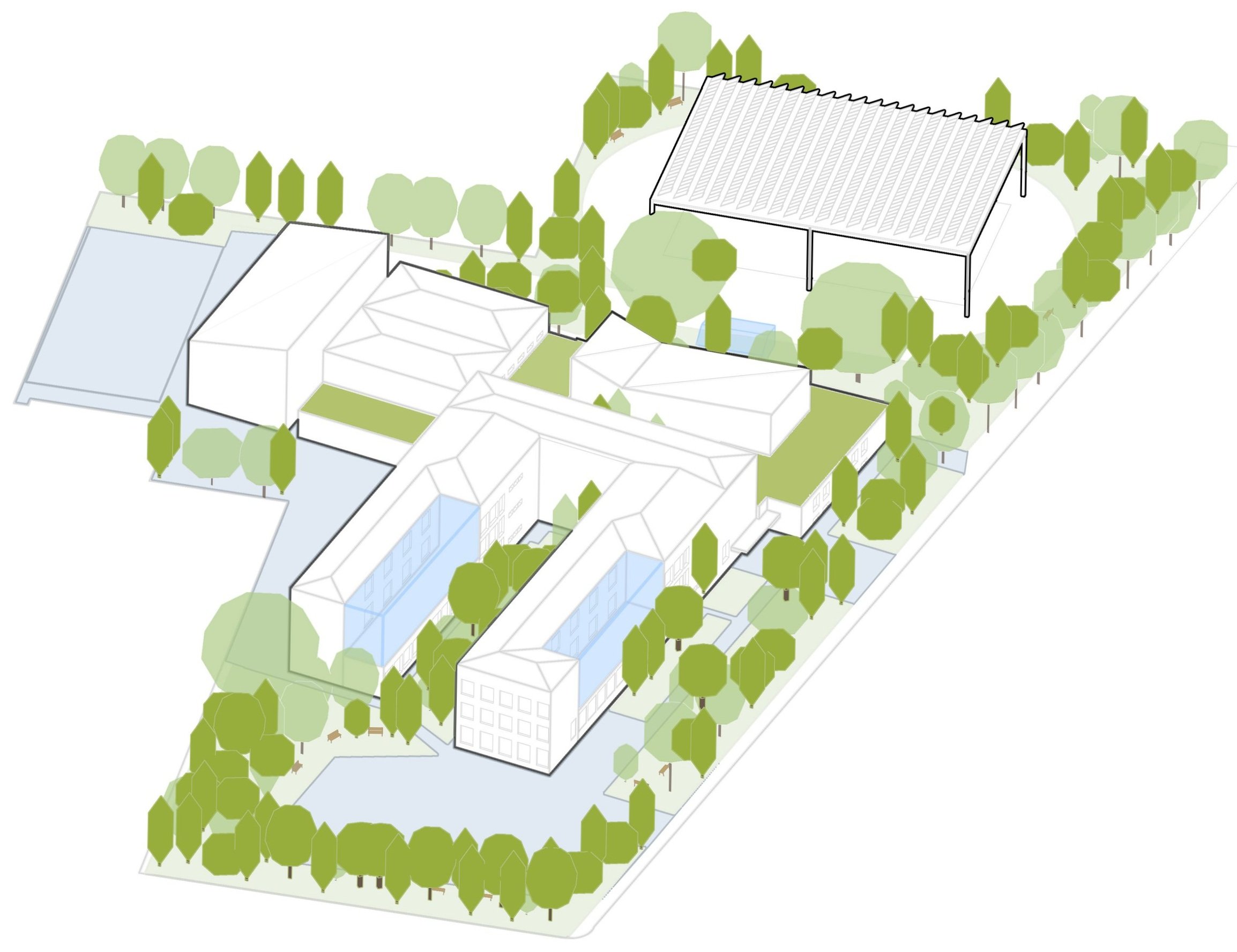
En el artículo científico se propone una estrategia de sostenibilidad innovadora que aprovecha las posibilidades específicas que presentan los centros educativos como una comunidad educativa abierta a su entorno. La escala es la célula urbana del instituto y su gran patio y su conexión con el entorno hasta la escala de barrio, incorporando temas como energía y comunidades energéticas locales, la participación y colaboración centro educativo - barrio, y otros con relación al cierre de ciclos.
La estrategia se realiza en tres grandes bloques o escalas: transición ecológica, transformación espacial del centro e innovación educativa en materia de sostenibilidad.
Los temas comprendidos en las diferentes escalas son transversales a estas y se pueden resumir en: movilidad verde, renaturalización, estrategia hídrica y cierre de ciclos, estrategia energética -reduciendo el consumo con estrategias bioclimáticas, obteniendo energía de recursos sostenibles y creando una comunidad energética local que puede compartir energía con el exterior- y la implicación y divulgación por parte de toda la comunidad educativa, incluidos los estudiantes, colaborando con otros centros cercanos y con el barrio.
Se trata de un tablero de juego que la comunidad educativa se ha apropiado y que ahora cuenta con una nueva versión actualizada por ellos, en un diálogo urbano a dos escalas. Un catálogo a varias escalas pensada para poder aplicarse medidas en un amplio abanico de posibilidades económicas y condiciones estructurales de los centros.
Se puede acceder al artículo en la edición nº30 de Planur-e.
Publication of a scientific article in Planur-e, a journal of territory, urban planning, landscape, sustainability, and urban design.
The scientific article proposes an innovative sustainability strategy that leverages the specific opportunities presented by educational centers as an educational community open to its surroundings. The scale ranges from the urban cell of the high school and its large courtyard—including its connection with the environment—to the neighborhood scale, incorporating topics such as energy and local energy communities, participation and collaboration between the school and the neighborhood, and others related to closing resource cycles.
The strategy is carried out in three main blocks or scales: ecological transition, spatial transformation of the center, and educational innovation in sustainability.
The topics included in the different scales are transversal to them and can be summarized as: green mobility, renaturalization, water strategy and closing cycles, energy strategy—reducing consumption with bioclimatic strategies, obtaining energy from sustainable resources, and creating a local energy community that can share energy with the outside—and the involvement and outreach by the entire educational community, including students, collaborating with other nearby centers and the neighborhood.
It is a "game board" that the educational community has taken ownership of and which now has a new version updated by them, in an urban dialogue across two scales. A multi-scale catalog designed so that measures can be applied across a wide range of economic possibilities and structural conditions of the centers.
The article can be accessed in the 30th edition of Planur-e.